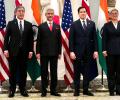
Soon after he was sworn in by Vice President J D Vance, US Secretary of State Marco Rubio hosted External Affairs Minister S Jaishankar, Penny Wong from Australia and Japan's Iwaya Takeshi for his first multilateral meeting as the top American diplomat.

In the context of India's energy ties with Russia, Putin said certain "actors" dislike New Delhi's growing role in international markets in view of its close relations with Moscow and these elements are aiming to constrain India's influence for political reasons by imposing "artificial obstacles".
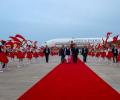
Prime Minister Narendra Modi arrived in China for the Shanghai Cooperation Organisation (SCO) summit. His meeting with President Xi Jinping is significant given global economic concerns.
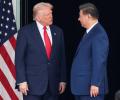
United States President Donald Trump said that China 'knows the consequences' if it attacks Taiwan, asserting that Chinese President Xi Jinping understands the situation 'very well'.

In their talks, Modi and Merz are likely to deliberate on trade and investment ties as New Delhi is looking at deepening economic engagement with Europe against the backdrop of Washington's 50 percent tariff on Indian goods, people familiar with the matter said.
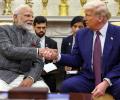
Amid trade tensions between Delhi and Washington, the NYT article gives an account of how relations between Trump and Modi "unraveled" after Trump's repeated claims of solving the four-day conflict in May between India and Pakistan, an assertion denied by India.

Prime Minister Narendra Modi and Chinese President Xi Jinping are set to meet in Tianjin on Sunday, their first in about 10 months, for wide-ranging talks aimed at improving relations.
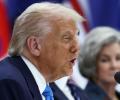
United States President Donald Trump on Wednesday said that the US is 'doing a trade deal with India' as the two sides continue to hold talks on the proposed trade pact.

'The longer India hangs out to dry, the worse the New Delhi-Washington relationship gets.'

Russian President Vladimir Putin, in a phone call this past week with United States President Donald Trump, demanded that Kyiv surrender full control of Donetsk, a strategically vital region in eastern Ukraine, as a condition for ending the war, said two senior officials familiar with the conversation, the Washington Post reported.

Prime Minister Narendra Modi will pay a three-day visit to the United States beginning September 21 to attend the annual Quad Summit and address the 'Summit of the Future' at the United Nations General Assembly.
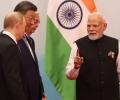
Russian Foreign Minister Sergei Lavrov on Thursday said the US threats of tariffs against India and China are failing and there is a growing understanding in Washington of the futility of talking in such language with two ancient civilisations.

This comes despite Russia on Monday stating that Lavrov and Rubio held a "constructive" conversation as part of preparations for the meeting between their two presidents in Budapest, Hungary, Russian media has reported.

New Delhi, while opting not to retaliate yet to the American tariffs, has in recent weeks sought to reinforce its friendship with Moscow, and recalibrate its ties with Beijing rather than surrender to Washington's diktats.

'There are very few issues and a political call needs to be taken about some of them.'
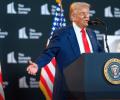
Former White House official John Bolton suggests that tariffs imposed on India by the US for purchasing Russian oil may have unintended consequences, potentially driving New Delhi closer to Beijing and Moscow.

United States President Donald Trump on Wednesday announced his upcoming diplomatic trip to Malaysia, South Korea, and Japan, highlighting a significant meeting with Chinese President Xi Jinping in South Korea.

While both sides have announced the decision to restart talks for a trade deal, government officials said discussions are continuing virtually.
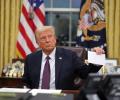
US President Donald Trump claimed India will stop buying oil from Russia, while also stating China will cut back substantially. He also discussed the conflict between India and Pakistan, reiterating his claim of helping settle the conflict.

I learn that success isn't measured in metres gained but in how we handle the moment when plans dissolve. The mountain doesn't grade on completion -- only on presence and effort, discovers Manoj Mohanka.
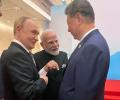
The relations between New Delhi and Washington are on a downturn after Trump doubled tariffs on Indian goods to a whopping 50 per cent, including a 25 per cent additional duties for India's purchase of Russian crude oil.
India has refuted claims made by NATO Secretary-General Mark Rutte that Prime Minister Narendra Modi contacted Russian President Vladimir Putin to discuss Russia's strategy on Ukraine in light of US tariffs on India.

Trump stated that Russia will face "severe economic consequences" if Putin doesn't show interest in de-escalating the Ukraine conflict.

United States President Donald Trump on Monday praised India and Prime Minister Narendra Modi without naming him, saying 'India is a great country with a good friend of mine at the top'.

US President Donald Trump claimed to have resolved the conflict between India and Pakistan, stating that 'seven brand new' planes were shot down during the conflict. He reiterated that he used trade as leverage to achieve this resolution.

Democratic Senator Jeanne Shaheen's comments came amid a major downturn between New Delhi and Washington after US President Donald Trump doubled tariffs on Indian goods to a whopping 50 percent, including a 25 percent additional duties for India's purchase of Russian crude oil.
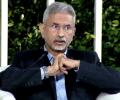
On President Putin's two-day trip to India, Jaishankar said for a "big" and "rising" country like India, it is important to maintain good cooperation with as many important players as possible in the world in line with freedom of choice.
He said both sides agreed to hold a meeting of senior advisers next week, led on the US side by Secretary of State Marco Rubio, before a proposed leaders' meeting in Budapest, Hungary.

Trump also praised Chinese President as "a great leader of a great country" and said the two sides had "already agreed to a lot of things."
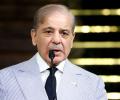
United States President Donald Trump is set to engage in high-stakes bilateral meetings on Thursday, including a closed-door session with Pakistan's Prime Minister Shehbaz Sharif in the Oval Office, according to Trump's public schedule released by the White House.

The Bloomberg report suggests that this backchannel communication from President Xi has laid the groundwork for a broader thaw in relations. This overture has since translated into a series of tangible diplomatic actions leading up to the upcoming Shanghai Cooperation Organisation (SCO) summit.

Prime Minister Narendra Modi and French President Emmanuel Macron discussed the Ukraine conflict and bilateral relations, reaffirming their commitment to global peace and stability.

Ever since the Quad started taking shape in 2007, China has been saying that the four-member grouping will be bound to fail. But much to the chagrin of Beijing, it picked up pace in the recent years emerging as a premier strategic group especially challenging China's assertiveness in the disputed South China Sea.

Russian President Vladimir Putin briefed Prime Minister Narendra Modi on his summit talks with US President Donald Trump on ending the war in Ukraine.
Sullivan remarks come amid the rising friction between Washington and New Delhi due to the 50 percent tariffs imposed on Indian goods, which include a 25 percent penalty for buying Russian oil.

A meeting with Chinese President Xi Jinping on the sidelines of the SCO summit is being planned.

Gor, 38, was among 107 nominees confirmed by the Senate in a single en bloc vote on Tuesday, with 51 senators voting in favour and 47 against.

Mohammed Shami was once ignored for the upcoming two-Test series against South Africa, despite having proved his fitness in the ongoing Ranji Trophy.
India has voiced regret over the Ukraine conflict's 'collateral consequences', including prices of fuel, saying countries of the Global South have been left to fend for themselves, as Delhi underscored that diplomatic efforts hold the promise to end the war and bring lasting peace.
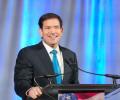
The US sees an opportunity to expand its strategic relationship with Pakistan but assures that it will not come at the expense of its ties with India, according to US Secretary of State Marco Rubio.
